SoGrein Framework
Context:
Waste is a by-product of the human existence and evolution. The topic warrants attention given the rapid rate of urbanization and the associated health, environmental and economic impact. Out of the total municipal waste collected, approximately 94% is dumped on land and about 5% is composted. Inappropriate disposal of such huge quantities of waste will have adverse consequences on the health and well-being of the people as well the environment. While this is a matter of global concern, the situation is exacerbated in developing countries which lack the infrastructure to deal with this issue. For example: India is among the top 10 countries in the world generating the highest amount of municipal solid waste. In 2019, India alone generated around 62 million tons of solid waste and this number is expected to increase to 165 million tons by 2030 (Ministry of Environment, 2016).
The Framework:
The proposed framework is targeted at bulk waste generators(BWG)as they contribute to-nearly 30-40% of the daily generated municipal solid waste. For the purpose of explanation, the case of a cooperative housing society has been considered and discussed in the following. This framework is generalized and hence can be applied to hostels, schools, colleges, senior citizen homes, hospitals. A pre-requisite requirement for this is that the BWG should segregate the waste into minimum three fractions: wet (organic/food scraps/peels), dry(packaging) and bio hazardous (sanitary waste) though more waste fractions can help the BWG and the associated civic authority earn more revenue.
Data & Methods:
This framework has been developed based on fieldwork started in 20151 in the Pune district and in Mumbai. It was prepared after contacting a variety of stakeholders such as ragpickers, consumers, NGOs, civic authorities, policy makers, academics and researchers2 .The main policy guideline used to develop this framework are the Indian Solid Waste Management Rules 20163. Local civic policy guidelines such as subsidies on property tax for under taking eco-friendly initiatives were also considered. This framework involved studying the MSW practices of three large cooperative housing societies4. Two of the societies had been awarded substantial property tax rebates due to a gamut of eco-friendly initiatives while one was modelling itself on the track (followed by the award winners) to qualify for earning financial subsidies in the form of property tax rebates. The process flow chart given below was prepared after observing the initiatives being undertaken by such exemplar BWGs.
Process Flowcharts:
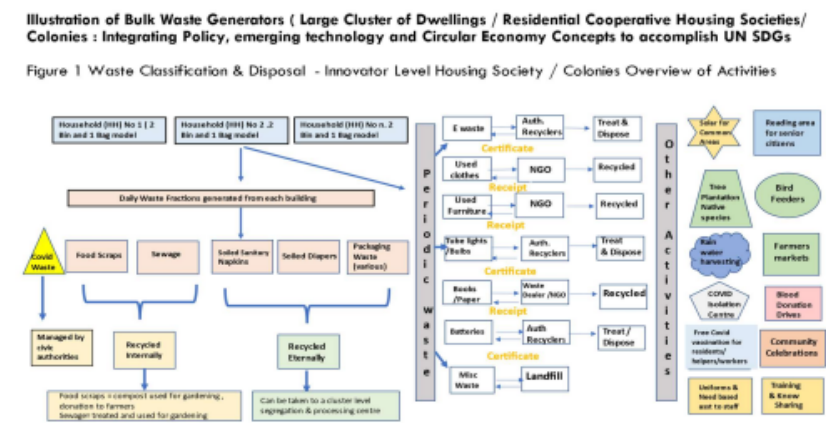
Fig 1 shows a model BWG’s MSW pattern. This model has been prepared based on a study of four societies located in the Pimpri Chinchwad municipal corporation (PCMC) limits and after consultation with the above mentioned stakeholders.The PCMC had stopped picking up food waste (or organic component of the MSW) from BWG effective5 2017 timeframe and asked them to compost the foodwaste. Only dry waste (recyclables) and bio-hazardous waste (sanitary napkins and diapers) would be picked up by the civic authority. They have also instituted a system of offering incentives such as subsidies on the property tax for BWG undertaking eco-friendly initiatives.
On the left side of the figure, are five waste fractions. They are food scraps, sewage water (toilet discharge), soiled sanitary napkins, soiled diapers, and packaging waste (can be sold to authorized waste dealers). Food scraps (can be composted) and sewage watercan berecycled on the premises of the BWG by installing a sewage treatment plant (STP) and compost bins. However, the three items namely soiled sanitary napkins, diapers and packaging waste have to be disposed outside the premises of the BWG. Packaging waste (dry waste) has to be given to waste dealers. It is segregated manually by the waste collectors. Sanitary waste is handed over to the civic authorities for disposal. Since this is a model society, it is undertaking recycling/reuse of sewage water (landscaping/gardening). Periodic waste management initiatives as well as socially relevant activities can also be undertaken by the model BWG – such as donation of clothes, used household items, books to an NGO and handing over e-waste and batteries to authorized recyclers. Miscellaneous waste is sent to the landfills.Such socially relevant and eco-friendly initiatives are shown in the middle portion of the flowchart while sustainability initiatives are shown in its right section of figure 1.
Challenges/Shortcomings of the present Approach:
In order to propagate such successful case studies, it is important to create a framework which will allow such initiatives to be available in a systematic manner in public domain. This need was echoed by civic officials and NGOs alike. At present the only way that such initiatives are known is via word of mouth (which are local in nature) or through occasional internet articles. The evaluation of eco-friendly initiatives for the purpose of awarding property tax rebates is done manually and the results are not available in public domain for reference. Civic authorities and policy makers want to accelerate the adoption of such sustainable initiatives at BWG points since they are stressed for resources and infrastructure. NGOs feel that the recommendations given in the SWM2016 need to be implemented and an excellent way which can result in a win-win situation is the through the implementation of extended producer responsibility (EPR) guidelines6 The companies (brandowners) are not complying with these guidelines. The exemplar BWGs on the other hand have to fund all of these eco-friendly and socially responsible initiatives through their funds. Property tax rebates received (if at all) offset partial costs a year after they are incurred. All the entities surveyed felt that a reliable data based framework that could help close the existing gaps and help BWGs monetize their initiatives would be very helpful.
The SoGReIn Framework :
This framework aims at combining the synergies of emerging technologies, community participation and policy guidelines to create a reliable data based approach which can : a) propagate the benefits of adopting sustainable waste management practices b) highlight use cases to help facilitate this process c) accelerate the adoption of UN SDGs through an environment friendly and inclusive approach d) create data that can be used in trust less environments e) facilitate the timely availability of data to facilitate governance and reduce the financial and infrastructure pressures on civic bodies through the implementation of EPR. f) enable responsible BWGs to monetize their efforts g) facilitate the transition towards a circular economy approach
There will be a central point (command room or CR) from which this activity will be managed7. A digital map of BWGs adopting the sustainable practices will be created on the SoGReIn website. In addition, a mobile app can be created. Recylables will be geo tagged and sent to a Resource Recovery Centre (RRC). Therethey will besegregated using robotic separation technology and artificial intelligence (AI). While the robotic segregation approach has been used in the developed countries, in case of India this is a recent occurrence. Community participation towards sustainable activities will be encouraged and a digital repository of the same will be created by accepting digital (visual) evidence of the same along with certain data required for verifying the authenticity of the submission. This activity will be done at CR. The brandwise data of the segregated recyclables waste will be used for charging various brands. The funds will be distributed among the civic authorities and the BWGs after deducting some administration and service charges (which will form the revenue for the CR). Blockchain technology will be used to enable data reliability/overcome trust issues8 Moreover greater transparency in evaluating the sustainability initiatives of BWGs will be possible.
The SoGReIn Framework :
This framework aims at combining the synergies of emerging technologies, community participation and policy guidelines to create a reliable data based approach which can : a) propagate the benefits of adopting sustainable waste management practices b) highlight use cases to help facilitate this process c) accelerate the adoption of UN SDGs through an environment friendly and inclusive approach d) create data that can be used in trust less environments e) facilitate the timely availability of data to facilitate governance and reduce the financial and infrastructure pressures on civic bodies through the implementation of EPR. f) enable responsible BWGs to monetize their efforts g) facilitate the transition towards a circular economy approach
There will be a central point (command room or CR) from which this activity will be managed7. A digital map of BWGs adopting the sustainable practices will be created on the SoGReIn website. In addition, a mobile app can be created. Recylables will be geo tagged and sent to a Resource Recovery Centre (RRC). Therethey will besegregated using robotic separation technology and artificial intelligence (AI). While the robotic segregation approach has been used in the developed countries, in case of India this is a recent occurrence. Community participation towards sustainable activities will be encouraged and a digital repository of the same will be created by accepting digital (visual) evidence of the same along with certain data required for verifying the authenticity of the submission. This activity will be done at CR. The brandwise data of the segregated recyclables waste will be used for charging various brands. The funds will be distributed among the civic authorities and the BWGs after deducting some administration and service charges (which will form the revenue for the CR). Blockchain technology will be used to enable data reliability/overcome trust issues8 Moreover greater transparency in evaluating the sustainability initiatives of BWGs will be possible.
In Figure 2 the mechanics of the process are shown. The robotic technology can help to identify the brand-owner and the type of packaging used for the respective product. For sanitary waste the charges can be determined on the basis of the weight9 and be charged to FIHA10.
Unique Aspects Innovation:
Data can be obtained from the CR about the revenue earned by the BWG by the implementation of the EPR rules laid down in the MSW 2016 guidelines. This revenue can be shared with the civic authorities (50:50) for using the civic infrastructure and also to cover manpower and administration costs. This will help realize tremendous savings for the civic authorities as nearly 50% of the municipal budget is spent on waste management activities.
Livelihood for waste pickers who can be involved in various aspects of this process: from the point of the origination to the point of disposal. Easily replicable and scalable solution that can help in accomplishing the UN SDG11 3: good health & well- being, SDG 5: gender equality, SDG 6: clean water & sanitation, SDG 9: industry, innovation & infrastructure, SDG 10: reducing inequality, SDG 11:sustainable cities & communities, SDG 12: responsible consumption & production, SDG 13: climate action, SDG 15: life on land.
A data based approach is currently absent due to the lack of awareness of the potential to realize the business case for implementing EPR as well as recovering the resource value embedded in the municipal solid waste.
Data can help citizens monetize their efforts: they can earn through proper disposal of waste; property tax rebates can be another incentive mechanism and sustainability maps can help pioneering BWG attract corporate social responsibility funds. Moreover, based upon the data, community members can negotiate bulk purchase rates and adopt circular economy practices by moving towards a packaging free approach - demanding that this be translated in lower purchase price for them.
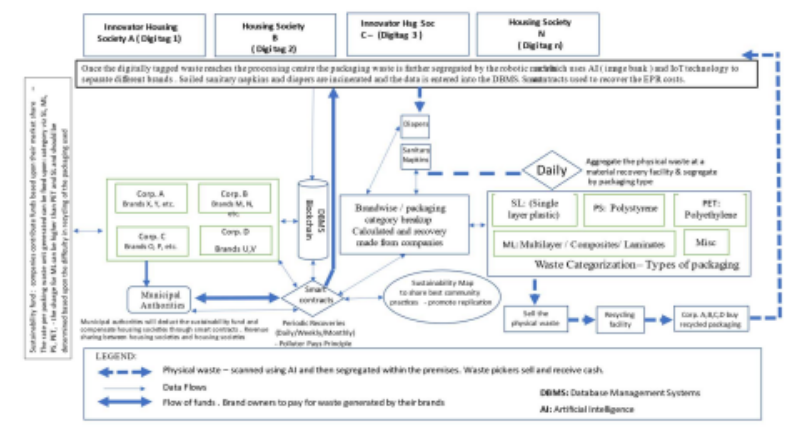
Emerging technologies such as AI have the capacity of storing thousands of images plus process the waste in an expeditious manner. Although some upfront investment will be required for setting up the systems and the software, EPR recoveries will be able to overcome the initial investments. Involvement of research institutes in developing the technology infrastructure will not only help to bring down the development costs but also generate scientific literature. Smart contracts help in automated recoveries from brand owners thereby reducing the transaction/funds processing times.
The digital map which is a part of the SoGReIn framework can be used to display the case studies of exemplar societies. A sample of the questionnaire is given below in Fig 4. This questionnaire will be used to collect data from BWGs. BWGs will be required to submit digital/photo evidence to substantiate the claims. Independent verification of the visual evidence and the data submitted will be conducted through independent volunteers.The services of such volunteers will be sought via the website/app which will host the SoGReIn framework.
Fig 4: The SoGReIn Questionnaire: BWG will provide this information and this will be cross verified by an independent entity
Name:
Location:
Temperature in Celsius on the date of filling in this information (automatically populated) Name of the Contact Person/s 1) …………………2)
Contact Numbers 1……………2)…………………
No of Dwellings:
No of Residents:
Demographic Data (As per govt census records/voters id list/self declared12)
No of males (18-60 yrs) No of males (> 60 years)
No of Women 18-60 years) No of Woman (> 60 years)
No of Girls :( 0-18 yrs) No of Boys (0-18 yrs)
Year of Establishment:
Ranking/Performance (previous year displayed)
Rating Done by:
Contact Number:
Level of Education:
Year……….Grade awarded …… (Calculated field)
Questions for the Evaluation:
A. Waste Segregation:
- Does the bulk waste generator (BWG) segregate organic waste and dry waste?
- Is the organic waste composted on-site?
- Is the composting unit fully operational?
- How many kgs of compost is generated per month?
- What is the time period required to convert organic waste into compost?
- Do you recycle tubelights and bulbs?Yes/No
- Do you recycle e-waste? Yes/No
- Do you recycle batteries: dry cell? Yes/N
- Do you recycle/conduct drives for used clothing, furniture, household articles? a. If yes provide the details of the i) name of the recycler ii) authorized by (state govt) iii)certificate number iv) issue date v) manifest number (if any)
B. Water Conservation:
- Does the BWG have borewell on-site?
- How many borewells?
- What is the amount of the annual water bill for the current year?
- What is the amount of the annual water bill for the previous year?
- Does the BWG have a sewage treatment plant (STP)?
- What is the capacity of the STP? …….litres/day
- Main uses of STP by the BWG: a) Gardening b) Flushing c) cleaning of basements/bathrooms/common passages d) car washing
- Dissolved Oxygen Level (DOL) checked: Yes/No
- Value of Dissolved Oxygen Level (above 5mg/litre is desirable)
- Does the BWG have rain water harvesting apparatus? Yes/No
- How many functional rain water harvesting apparatus are there?
- How much approximate water is harvested through roof top rain water harvesting systems14 (formula given in the Govt of India Central Public Works Dept)
- Did random checks of the taps and pipes in the BSW location reveal any leakages, broken devices? How many such instances?
- Does the BWG have any drip irrigation applications for gardening/landscaping? How many points?
- Does the BWG have any building wise incentives programmes for lower water bills?
C. Green Cover Enhancement:
- Is there space available for conducting tree plantation activities within the premises of the BWG? Yes/No
- Has this space been fully utilized?
- What kinds of green cover plants do you see: a. Medicinal Plants &Herbs b) Trees Local varieties c) Flowering plants& shrubs d) Some grass and decorative plants e) Exotic plants f) Fruit trees g) No plants
- Age of the Plants: a) 0-3 months b) 3-6 months c) 6months-1 year d) > 1 year
- Number quantum of green cover: here there will be a drop-down menu based on the answer given in question iii.
- Have you sponsored any tree plantation activity in the past one year? Yes/No
D. Clean Energy:
- What form of renewable energy do you use? a) Solar b) wind c) hydro d) combination e) none
- When (year) did you adopt this initiative? Drop down to provide details about the year
- What is your average annual generation of alternate energy?
- What is your cost savings in rupees this year versus the previous year?
- Do you have surplus energy units? Yes/No
- If yes, how many units are you interested in selling?
- What is the time duration for which you can commit a supply of these units? (given in iv)
- What are the main uses for the alternate energy? a. Lighting common areas within the complex b. powering machines and equipment used in the complex c. other (provide details)
E. Diversity & Empowerment:
- How many workers do you have in total? a. How many are your regular employees and how many are contract employees?A)ContractB) Regularemployees
- How many are in the admin function?
- How many are in the maintenance function? a. How many workers from your total staff strength are: a) Women b)Belong to economically challenged background?c)Belong to SC/ST/ NT/OBC castes?d)Have any physical disabilities?
- Do you offer your employees health insurance benefits? Yes/ No
- If yes do you provide full coverage or partial coverage?
- Are the spouse and minor children covered?
- Medical Insurance coverage? Yes/No
- How many workers from your total staff strength are contract employees? ix. Do you require the contractor to provide health and medical insurance to workers? x. Do you provide emergency financial help to your employees and/or contractors? Yes/No
F. Use of Technology:
a. Are your day-to-day operations automated? Yes/Noa)Fully automated b) Partially automated c)Mostly manual Do you have an automated records of your: a) Compost b) packaging waste c)sanitary waste d) E-wastee)Glass f)Newspapers/Books/Paper g)Household items donated to charities
- Are you planning to automate your data? Yes/No/NA a. How do you communicate with your members? a) WhatsApp b)Facebook c)Apartment Adda Software d)Any other software (pl provide name) e)Telephone calls f)Notice Board) Combination (provide details of options used from a to f)
- Do you have a mechanism to offer financial rewards/waiver of charges to model buildings that consistently at the forefront of implementing the items listed in the SoReGreen framework? Yes/No
- If yes, how do you reward such champions? a. Acknowledge them and appreciating their work b. Providing them with a waiver in their monthly service charges c. Both a & b d. None of the above
- Do you have automated warnings that are issued incase of need? Yes/No a. To a building b. To a resident c. Both are done
- Would you like to be connected to a database that allows you to get data about the different types of brands used by your residents that are thrown as packaging waste and or sanitary waste? Yes/No
- Would you be willing to pay for access to such services? Yes/No
- Would you like to be paid for segregating your waste and managing its disposal: Yes/No viii. Would you be willing to incur expenses for this purpose? Yes/No
- If yes would you be willing to pay for: a. Digital tags b. Initial investment in the hardware/software c. Manpower (supervisory and waste workers) x. What software do you use for your office admin? a. MS Word, Excel and PowerPoint b. Tally c. Other
G. Improving Fauna in an urban setting :
- Do you have any water dispensers for birds located in your complex throughout the year? Yes/No
- Do you have any bird feeders placed in your complex throughout the year? Yes/No
- Do you support any organizations/initiatives that promote urban fauna? Yes/ No If yes provide the details of the: name, registration number, amount, date of contribution.
H. Sanitary Waste Management :
- Do you segregate used sanitary napkins and diapers? Yes/No. If Nothen skip this section If yes, proceed to the net question.
- What is the weight (in kgs) of the sanitary napkins discarded from your society every day? vi. What is the weight (in kgs) of the soiled diapers discarded from your society every day? vii. How many people are engaged in collection, weighment and the disposal of diapers/sanitary napkins?
- Currently are you getting reimbursed for disposing off the sanitary waste? Yes/No
I. Covid Management& Control :
- Do you handover waste from Covid patients to the civic authorities? Yes/No
- Do you have sanitizers easily available for use by residents, vendors, domestic helpers etc in your society?
- Do you have handwash facilities easily available for use by the residents, vendors, domestic helpers etc in your society?
- Have you conducted a Covid vaccination drive in the past one year for your members? Yes/No
- Do you have a Covid 19 isolation facility available in or nearby your complex?
- Have you conducted RT-PCR tests for your staff in the past six months?
- Do you continue to pay your staff their full salary when they are on leave due to Covid infection?
- Do you assist your residents in arranging the basic necessities such as groceries, medicines etc when they are confined due to Covid?
- Have you conducted any wellness, health information training sessions for your residents? x. How many Covid positive cases have been reported in your society in course of April 2020- till date?
- How many recoveries have you had since April 2020-date?
- Do you have a Covid waste disposal protocol communicated to your members?
- Have you recovered any fines for Covid rules violations from April 2020- till date?
J. Use of Industrial ByProducts :
- Do you use bricks,paver blocks made from construction & demolition waste (CDW)? Yes/No If no, then would you be interested in using bricks & paver blocks made from CDW?
- Why have you not used CDW products? a. Did not know b) they are not of good quality c) cost issues d) durability concerns e) other
- If Yes, how do you procure these items? a. Through vendors located online b) Through vendors referred by the municipal authorities c) Through vendors who have approached us d) Other sources
- Who pays for the transport cost? a. the seller b) the society c) we share the transport cost d) other
- Have you ever used: a. soil/sediments recovered from the ocean/ water bodies for gardening purpose? Yes/No? b. Bricks, blocks made from agricultural waste for repair, construction work? Yes /No c. Steel slag as fertilizer for gardening? Yes/No
- If no, would you be interested in using items a to c listed in question v above? Yes/No
- If yes, what were the main reasons that prompted your society to use these products? a. Eco friendly b) durable c) cost effective d) were offered free e) better than the current products that we purchase f) other
- How do you dispose the CDW generated by the residents in your society? a. They pay for the transportation/disposal b) we have a pick-up arrangement with recyclers c) don’t know d) it is thrown along with the municipal waste e) other
- How do you dispose the CDW generated during repairs conducted in your society? a. We pay the contractor for the transportation/disposal b) we have a pick-up arrangement with recyclers c) don’t know d) it is thrown along with the municipal waste e) other